







Discouraged residents crave transformative housing leadership

This United Insights post is adapted from the Social Research and Planning Council’s recent report, Our Stories of the Housing Crisis: Findings from the Cost of Housing Survey.
From January to April 2024, the Social Research and Planning Council’s Cost of Housing survey heard from 716 Perth-Huron residents who reported being affected by rising housing costs. Respondents were asked open-ended questions about how they were affected, how they adapted and what they wanted to share with leaders. Our report is structured around the most common themes across the dataset.
In previous posts, we focused on themes directly related to housing itself, then how housing costs send ripples through people’s lives. In this final post, we’ll cover how respondents explained the crisis and what they want to change, plus our recommendation to increase the community housing stock.

Both the Public Sector and Private Sector are Seen as Contributing to the Housing Crisis
Many respondents made comments suggesting explanations for the housing crisis. Similar numbers of respondents pointed the finger at the public sector (22%) and the private sector (17%). Some respondents called out both:
“The economy and government are horrible.” ~ Ashfield-Colborne-Wawanosh
Decision Makers “Don’t Seem to Notice or Care”
A frequent comment about the public sector was that politicians and public servants do not understand the concerns of affected local residents. “I would like the decision makers to be given the money that the government gives a person on disability, or that a person earns working a full-time job at minimum wage,” said a Goderich resident. “They need to live it to know how bad it really is.”
As well as being unaware, the public sector was often described as uncaring. “Is there a point…? They don’t seem to notice or care if people struggle,” said one respondent from North Perth. Decision makers were seen as neglecting established rural residents in favour of tourists, foreign investors, new residents, and urban communities. “The federal government is only recognizing the housing needs of large urban communities in their funding decisions. Small urban and rural communities are being ignored,” said a respondent from Huron East.
Distrust of Developers and Landlords
4% of respondents criticized developers for what they choose to build. “There are too many high-end builders in St. Marys, making it impossible for average-income people to buy,” said a St. Marys resident. Some respondents saw businesspeople as having little interest in serving them: “My landlord has decided to sell my home instead of allowing us to stay because he can’t charge ‘going rate.’ The cost of housing is based solely on greed,” said a Morris-Turnberry respondent. 6% of respondents commented on landlord misbehaviour, including renovictions. This Central Huron respondent was more even-handed, while still criticizing the private sector for profiting from a crisis: “Landlords have to cover rising costs too, but many are over-pricing units by significant amounts because there is a shortage in availability and they know people are desperate.”
I Realize There’s Nothing You Can Do
Some commenters saw both the public and private sectors as benefiting from unaffordable housing: “Local governments like big investors to come from cities, scoop up a few acres and sell a postage stamp for city prices, because they can collect tax and waste it on a statue of a white squirrel or a crosswalk,” said a respondent from South Huron. Other comments viewed the government as being ineffective or powerless to create affordability, as in this note from Perth South: “I realize there’s absolutely NOTHING you can do about the housing situation since it’s all run by BIG BIZ.”

High Housing Costs are Considered Unfair
While respondents offered explanations for the housing crisis, they did not see it as justified. Instead, a third of respondents highlighted ways in which current housing costs seem unfair. “These prices are not affordable,” said one St. Marys resident. “They’re not affordable for people with well-paying jobs, they’re certainly not affordable for people without.”
It Shouldn’t Take Three Full-Time Incomes
Many respondents shared a belief that housing ought to be affordable for hard-working families. “It shouldn’t take three full-time incomes to own the average house these days,” said a North Perth respondent. A Central Huron resident noted, “My partner and I can’t put food on the table and pay all the bills on time while both working full-time jobs that pay well above minimum wage.” From West Perth: “I work my ass off to afford to survive, but I can’t survive with how high the cost of living is.” This Perth South comment highlighted the irony that what looks like a decent income “on paper” may not be enough to afford housing, while being enough to block access to supports:
“I am an educated person who works full-time at a good job and ‘should’ be able to meet ends meet, so I don’t qualify for subsidies or assistance. I’m living paycheque to paycheque.” ~ Perth South
Our Only Hope is to Win the Lottery
Housing costs were often described as crazy, absurd, or ridiculous. A North Huron resident summed up the feeling of many respondents: “Someone just posted a one-bedroom apartment, in Wingham, for $2,000 a month. THIS IS WRONG!” This comment from Stratford highlighted a sense that luck is the only way to afford housing costs: “We paid $500,000 for our semi-detached home and that was a good price! There’s no way a house of our size should be that expensive! How do you expect anyone to get ahead!? Our only hope is to win the lottery!” A Huron East resident echoed this observation: “Eventually only the wealthy will be able to eat and maintain their homes, which is so sad.”
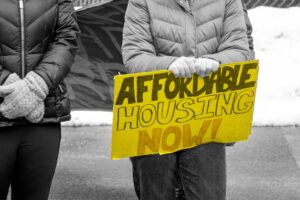
Perth-Huron Residents Want Action on Housing Costs
Respondents were eager for this crisis to end, with 61% commenting on the need for change and possible solutions. “Some serious changes need to be made,” said a Huron East resident. “The government needs to take responsibility for the current state of our country and economy and do what is needed to correct it.”
It’s Real People Behind the Cries for Help
20% emphasized the urgency and unsustainability of the situation. Some drew attention to the stakes for their household: “I want decision makers to understand it is real people behind all the cries for help. I personally am one paycheque away from homelessness and I have a child I’m solely responsible for,” said a respondent from West Perth. Others pointed out the broader implications of unaffordable housing, as in this comment from St. Marys: “The cost of housing is keeping valuable workers, especially young ones, from living and working in the community.”
Basic Housing Should Not be Out of Reach
Some respondents stressed that housing is a basic need and a human right. “To have a productive and functional society one needs to have security and safety,” said a respondent from Central Huron. “This includes knowing that one’s basic needs are being met.” Access to housing was described as a standard our society ought to meet. “Basic housing should not be out of reach for so many. Something has to be done,” said a Goderich resident.
Do Everything in Your Power
7% of respondents made clear calls for decisive action. “If you can make an impact on these ridiculously high house prices, please do,” said a South Huron respondent. Comments called for efforts scaled to the size of the problem. A North Perth local wrote, “Do everything in your power to please bring down inflation, bring down rent, and bring down mortgage interest rates before more people lose their homes.”
Taking Years to Act Isn’t Good Enough
Respondents expressed frustration at sluggish public responses: “Repeated studies and consultants and taking years to act isn’t good enough anymore,” said a respondent from Perth East. A Stratford resident emphasized the duty of public officials to represent affected residents:
“The current situation is not viable. There cannot be any decision makers thinking, ‘Oh well. People will have to adapt.’ Please use your power to support the people you are paid to represent! This is why your job exists!” ~ Stratford

Perth-Huron Residents Want Affordable Housing
46% of respondents called for various measures to make housing more affordable. Suggestions broke down into several themes. The largest was summarized by a South Huron local:
“Affordable housing, affordable housing, affordable housing.” ~ South Huron
More Smaller Homes, More Apartments
26% of our sample called for more housing to address the housing crisis, and 19% stressed the need for affordable housing in particular. 7% suggested that developers could build a greater variety of “missing middle” market housing at more affordable prices, as in this Goderich comment: “We need more smaller homes, more apartments. What a lot of young people need is just a little bungalow. Like, I barely even need a yard.”
We Need Far More Subsidized Housing
Comments supporting affordable housing often highlighted the fact that the most affected households cannot afford market-rate housing: “There needs to be more housing for people who live on a very limited budget,” said a West Perth resident. Solutions beyond the market were seen as necessary for groups like seniors. “The parent in my home is extremely isolated and lonely and would love to live in a retirement setting but can’t afford it. We need more affordable, not-for-profit supported living environments for seniors on fixed incomes,” said a respondent from North Huron. New non-market units are also needed for some people with disabilities, as noted by a North Perth resident: “In our home, we have young people with disabilities and the waitlist for housing is ridiculously long. We need far more subsidized housing in North Perth. Two or three units is not enough. We need dozens.”
Drastic Times Call for Drastic Measures
That comment and others highlighted the scale of the response needed to fill the gaps in the market. “Drastic times call for drastic measures,” said a St. Marys respondent. “The reality is we need governments at local, provincial, and federal levels to just pony up and build. The cost of housing is pretty easily solved by creating a large wave of new units.”
Bringing Down Costs and Controlling Increases
Supply was not the only focus of these responses. 11% of respondents simply wanted housing costs to come down. 10% recommended some kind of rent or price control, reflecting a distrust in private developers and landlords. “Most landlords have just increased their rent because they can!” said a Bluewater resident. “They need to find a way to stop rent increases, or minimize them, or set them, monitor them, something, somehow. We need to fix the root of the problem.”
Think Boldly and Creatively
While these comments often expressed doubts about the intentions and capabilities of decision makers, they also expressed a yearning for change and leaders who deliver it. A comment from Perth East got at this desire for effective leadership: “My hope is that our decision makers will think boldly and creatively about housing solutions, work collaboratively across different sectors, and make choices that prioritize the holistic well-being of all Canadians.”

Recommendation: Build the New Community Housing Perth-Huron Needs
The support for affordable housing expressed by survey respondents reinforces a growing consensus that the community housing stock should be expanded. New community housing is needed both to meet the demands of ongoing population growth and to make up for decades of underinvestment. Our targets and investments in new community housing should be scaled to this reality.
We call on individuals, organizations, and especially governments to set ambitious regional targets for new community housing and make serious investments to achieve them.
Pulling Together
A new generation of community housing will only become reality through widespread collaboration. Individuals and organizations can contribute money, land, and other resources to community housing providers, while advocating to government for bigger investments. Smaller municipalities can create supportive conditions for community housing, while larger municipalities and non-profit builders can plan exciting builds to attract funding.
Most importantly, a new generation of community housing will require the Governments of Canada and Ontario to invest in the long-term funding and low-cost financing needed to build new community housing at scale in rural regions like Perth and Huron.
Maintaining Momentum
Some promising activity has already begun. The City of Stratford, County of Huron, United Way Perth-Huron, and other organizations have taken major strides to kick-start new community housing development in our region. The Government of Canada has announced a new agency to “build affordable housing at scale.” The Government of Ontario has made ongoing investments in affordable housing, particularly to end encampments.
We can build on these foundations as we set regional targets with serious plans to achieve them. In the words of one Bluewater resident:
“The system we currently have is not working and it is time to reimagine. We have nothing to lose and everything to gain.”
Read the full report now: Our Stories of the Housing Crisis: Findings from the Cost of Housing Survey.
United Insights: A Research Blog by SRPC
Subscribe to get United Insights in your inbox.
Got research-loving friends? Send them this post!
Did your research-loving friend send you this? Subscribe