






What local data reveals about our workforce.
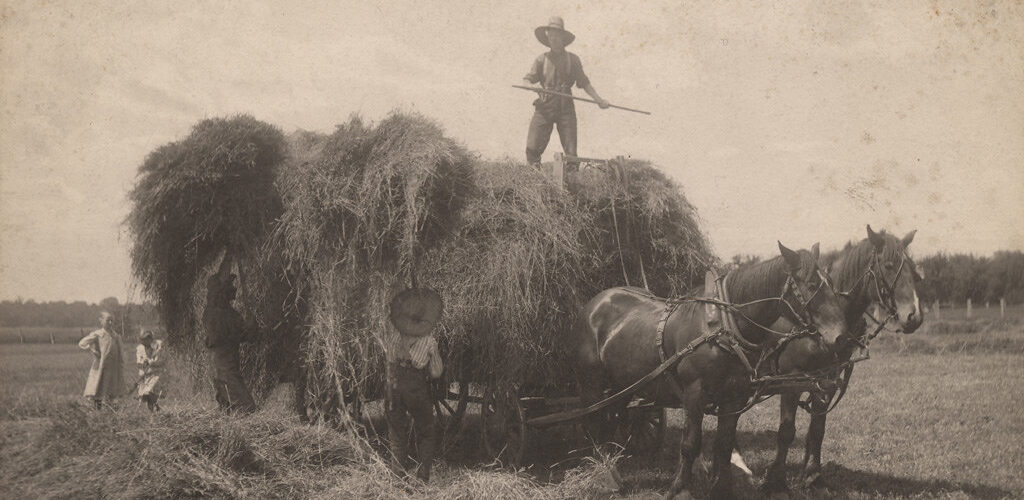
A farmer loading hay, date unknown (pre-1937), from the archival collection of the Huron County Museum.
This is a post by Jordan Meisel, Labour Market Research Coordinator and Kee May Ip, Labour Market Analyst with the Four County Labour Market Planning Board (FCLMPB).
We often hear about the uniqueness of our region – the thriving arts and culture scene in Perth, Huron County’s rich agricultural landscape, the natural beauty of Bruce County with its many outdoor adventures, and the many bustling towns within the County of Grey. This uniqueness extends to the region’s labour market as well, with the Four County Region experiencing certain labour market conditions that set it apart from other economic regions in Ontario and present distinct opportunities and challenges. This is documented in our annual Local Labour Market Plan (LLMP).
Our Labour Market is Tight
One of the most well-known labour market indicators is the unemployment rate. The Four County Region (also known as the Stratford-Bruce Peninsula Economic Region) has experienced a chronically low unemployment rate for the past decade, especially when compared to provincial rates. The unemployment rate in the region sat at 4.6% in 2025, significantly lower than that of the province at 7.7%.
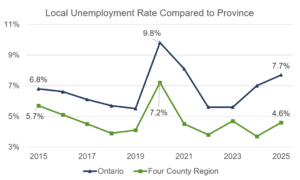
Figure 1. Local Unemployment Rate Compared to Province. Source: Statistics Canada. Table 14-10-0464-01 Labour force characteristics by province, territory and economic region, annual
While a low unemployment rate can be indicative of a strong economy, chronically low unemployment rates as experienced in our region have resulted in hiring challenges and worker shortages in key employment sectors.
In the 2024-25 EmployerOne survey, over half of respondents (51%) ranked the impact of the regional labour shortage as a 4 out of 5 or higher.
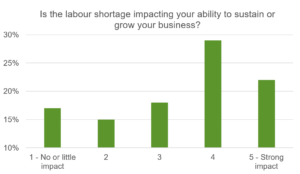
Figure 2. Is the labour shortage impacting your ability to sustain or grow your business? Source: Four County Labour Market Planning Board, EmployerOne Report 2024-25. https://www.planningboard.ca/reports/employerone-2024-25/
A respondent commented that “The aging workforce we have is not sustainable. They can’t continue to do the work.” Yet, there are challenges in replacing exiting workers. Employers find that “a lack of ‘things to do,’ i.e. nightlife, lack of diversity in cuisine/restaurants” impacts their efforts in recruiting a younger generation of workers for some sectors. In addition, some employers are experiencing difficulties in filling job vacancies because of the “lack of qualified individuals” or the number of “individuals whose qualifications are not relevant in Ontario (e.g. teacher [trained] in another country but does not have Ontario teacher’s certificate and cannot teach in Ontario).”
Another employer pointed out that certain sectors and businesses face challenges in recruiting and retaining workers when they can’t offer competitive pay, as workers are drawn to higher paying sectors due to a high cost of living. In addition, upskilling programs that require participants to spend weeks away from work or home are not always affordable, particularly for younger workers, because of the associated costs of commuting, accommodation, meals, and tuition.
Our Workforce is Aging
One of the most notable trends in the region is the rapidly increasing senior population (aged 65+). While most age cohorts in the region have experienced modest growth, the senior population experienced the largest percentage growth between 2021 and 2025, rising by 16% or 12,832 people. The Four County’s total population aged 15+ is now made up of 31.4% seniors, compared to just 22.1% across the province.
The median age of our region’s population in 2025 sat at 45.4 years, compared to the provincial median age of 39.9 years. A few years ago, 2021 Census data showed that the median age of both Huron County (46.8) and Perth County (42.4) were higher than Ontario’s median age of 41.6. Most municipalities in Huron County had median ages higher than that of the province, with the Town of Goderich (median age at 52.8) showing the largest difference. In Perth County, the Town of St. Marys reported the highest median age at 48.4. Overall, not only is our region older than the province, but it is getting older at a faster rate, hastening the impact on local healthcare systems and social services.
It’s also important to compare the rate of the region’s population growth to the region’s labour force growth. While the region’s population (aged 15+) has increased by 8.1% over the past five years, labour force growth has not kept pace, only rising 3.4% over that same time period.
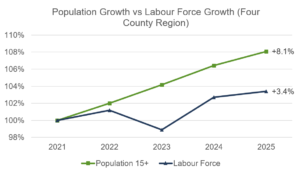
Figure 3. Population Growth vs Labour Force Growth (Four County Region). Source: Statistics Canada. Table 14-10-0464-01 Labour force characteristics by province, territory and economic region, annual
This suggests that an increasing proportion of the population is either aging out of the workforce or otherwise not seeking work. For comparison’s sake, when looking at provincial levels, population growth and labour force growth were nearly synonymous, both rising by 11% between 2021-2025.
The imbalance between population growth and labour force growth results in higher dependency needs, wherein a smaller workforce is supporting an ever-increasing number of dependents (both children and seniors). As of 2025, the Grey-Bruce Health Unit had one of the highest demographic dependency ratios of all health units in the province at 76.4%, meaning there were 76.4 dependents per every 100 working-age persons in Grey-Bruce. Huron-Perth sat at 70.8%. These numbers compare to Ontario at just 50.3%.
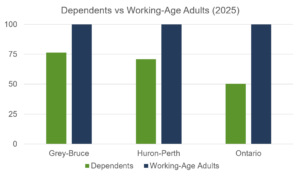
Figure 4. Dependents vs Working-Age Adults (2025). Source: Statistics Canada. Table 17-10-0156-01 Demographic dependency ratio, July 1, by health region and peer group, 2023 boundaries
While the province’s demographic dependency ratio has remained relatively stable since 2019, the ratios have consistently increased year-over-year in all four counties. This results in a limited workforce supporting an ever-increasing number of dependents.
Local healthcare and social assistance workforces also saw a drop, losing 2,100 workers between 2021 and 2025, despite increasing labour demand in this sector due to population growth and the aging population.
Our Region’s Cost of Living is a Barrier to Attracting and Retaining the Workers We Need
There is a significant gap in our region between the cost of living and median wages. This may be pushing workers away from our region to other areas that offer a more comfortable cost of living. The 2025 living wage for Grey Bruce Huron Perth Simcoe sat at $24.60. The region now sits just behind the Greater Toronto Area (GTA) as the second highest living wage in the province. Neighbouring living wage regions, including London Elgin Oxford and Dufferin Guelph Wellington Waterloo, all have lower living wages than the Four County Region.
Despite the high cost of living, the average hourly wage in the Four County Region is consistently below the provincial average. In Quarter 1 of 2026, the average offered hourly wage (for the total of all occupations) in Ontario sat at $30.70, whereas the Four County Region lagged behind at $26.95.
When examining the top 10 occupations by job postings in Huron-Perth over the course of 2025, there were 3 occupations with a median hourly wage above the region’s current living wage. As shown in the table below, job demand in Huron-Perth is highest in some of the lowest-paying occupations, which struggle to attract and retain staff amidst the other labour market conditions we discussed.
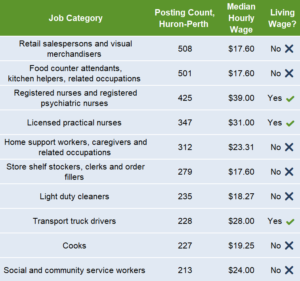
Figure 5. Postings by Count, Job Category, Median and Living Wage (Huron-Perth, 2025). Source: connect2JOBS.ca Labour Market Insights Report 2025; Government of Canada, Job Bank.
There are signs that the cost of living is affecting people’s labour market interaction. For example, between 2021 and 2025, the age 65+ labour force experienced the largest growth in labour force size of all age cohorts, increasing by 5,200 people. With ongoing economic uncertainty and an increasing cost of living, more seniors may be opting to remain in the labour force due to financial need.
Signs of Resilience
While the Four County Region is facing some labour market challenges, its resiliency has been showcased recently during the pandemic and the ongoing trade and economic uncertainties. The labour force has consistently increased year-over-year and employment continues to rise in key employment sectors like construction and retail, with a large impact anticipated in clean energy jobs.
In the coming years, the attraction and retention of youth aged 15-24 years and core- aged workers (25-44 years) in the region will prove increasingly important in sustaining the workforce amidst a large wave of retirements. There are a number of positive signs when it comes to youth in the region’s labour market.
Firstly, migration data show that the number of out-migrants aged 18 to 24 decreased between 2007-12 and 2019-24, suggesting an improvement in youth retention. Secondly, the number of in-migrants in the same age cohort has increased, suggesting that Huron and Perth Counties are attracting more youth.
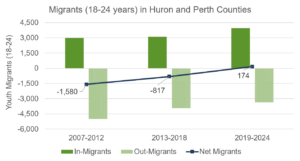
Figure 6 Source: Migrants (18-24 years) in Huron and Perth Counties. Statistics Canada, Taxfiler, custom tabulation.
Thirdly, a combination of low unemployment rate and high workforce participation rate in the Four County Region (Stratford-Bruce Peninsula) is evidence of a tight labour market that potentially constrains the region’s ability to address persistent labour shortages. However, in 2025, neighbouring economic regions and Ontario overall reported higher unemployment rates for the 15-29 years age cohort, suggesting a potential pool of younger workers that employers in our region could draw from.
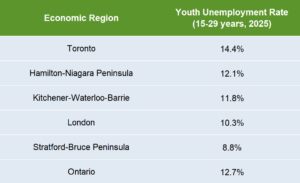
Figure 7. 2025 Unemployment Rate (15-29 years) Comparison. Source: Labour Force Survey, custom tabulation
A report recently released by the FCLMPB, Youth on the Move: Examining the Why, is dedicated entirely to this topic and emphasizes the importance of youth retention and youth-focused strategies to encourage the “return” of youth to the region.
For more local labour market research, check out the Four County Labour Market Planning Board website: www.planningboard.ca/reports
United Insights: A Research Blog by SRPC
Subscribe to get United Insights in your inbox.
Got research-loving friends? Send them this post! (Did your research-loving friend send you this? Subscribe!)
Love this post? Strongly dislike it? Got suggestions? Let Us Know
Got an idea for a post? Pitch It