



An Interview with Anne Coleman.
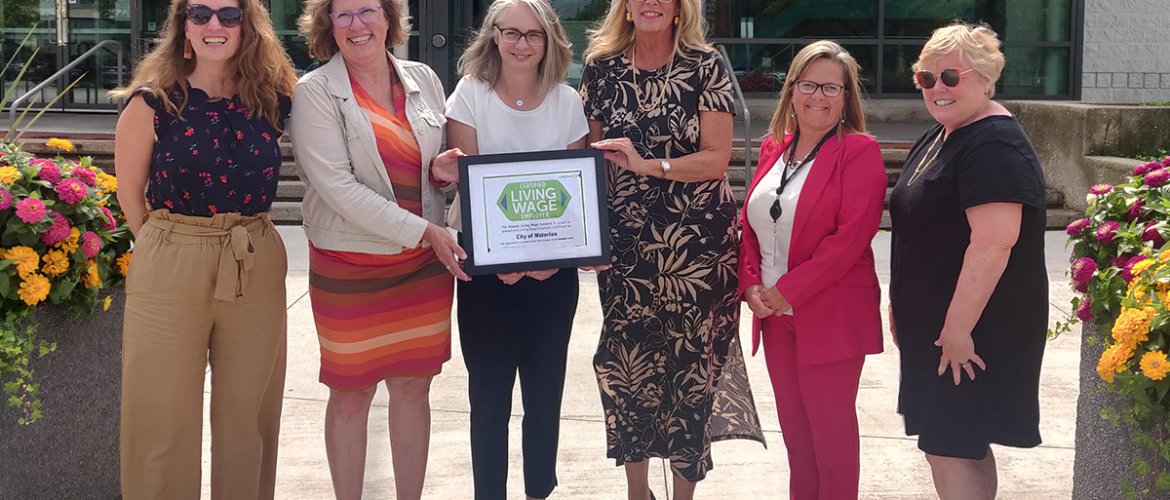
Staff and city representatives celebrate the City of Waterloo’s certification as a living wage employer. Ontario Living Wage Network Executive Director Anne Coleman is pictured third from left. Photo courtesy of Ontario Living Wage Network.
Today’s post comes in the form of a podcast! November 9th to 13th is Living Wage Week across Ontario. United Way’s Will Wellington sat down with Anne Coleman from the Ontario Living Wage Network to discuss what the living wage is, how it’s calculated, and the impact it has on our communities. Watch the podcast on YouTube or read the transcript below.
For more information about the living wage, and to find local living wage employers, visit the Ontario Living Wage Network website.
This transcript has been edited for clarity.
Will Wellington: Hello everyone. My name is Will Wellington, I’m with United Way Perth Huron, and I’m here today speaking to Anne Coleman. Anne Coleman is the Executive Director of the Ontario Living Wage Network. And we’re here today because it’s Living Wage Week, November 9th to 13th. We’re announcing new living wages, including for our region Perth-Huron, where the living wage is going from $24.60 an hour to $24.75. Anne, thank you for being here.
Anne Coleman: Thank you, Will. I’m really happy to be here and have the opportunity to talk about the living wage in Ontario.
Will Wellington: Okay, so I want to start with the big picture questions. What is a living wage? Why is it calculated the way it is? Why does it matter?
Anne Coleman: Great questions. So, the living wage is an hourly rate that a worker needs to earn to cover not just their basic expenses, but to have a little bit extra so they can participate in community. That being said, it’s still a very modest wage. When we do our living wage calculations, we have a group of basket items or expenses that someone would have each year. And we collect data from the local community to ensure that we come up with a living wage rate that ensures people can make ends meet. They can pay their bills. They don’t have to make those tough decisions between putting gas in the car or purchasing healthy food. They should be able to cover all of those basic expenses.
Will Wellington: What’s included on both sides of it? Because it gets pretty detailed — it’s about how a wage fits into a whole life, right? Walk me through both sides of the calculation.
Anne Coleman: Sure. So, it is a fairly complex calculation. I mentioned that we have a list of basket items that we collect data for. The basic essentials: things like the cost of rent and food, transportation, childcare. We also have an “other expenses” category that includes some necessities, personal care items, laundry — but this is also where you’d find that little bit extra so that children can participate in after school activities, or so you can afford birthday presents for your children. That sort of thing.
Once we collect that data, we look at three different household types. We look at a family of four with two working adults and two children, a single parent with one child, and a single individual. We collect the annual expenses for those three different household types, and then we do a weighted average based on how common those household types are within our province to find the annual expenses and therefore the living wage rate. So that’s the expense side of things.
I should mention, as well, we take into account government taxes as well as any transfers — things like the Canada Child Benefit, for example. That’s all included, as well as EI and CPP premiums. We have a calculator tool and all of the data is run through that tool to provide the living wage rate.
Will Wellington: Why is it so important that we understand the living wage rate for our region?
Anne Coleman: There’s a tendency to compare living wage rates across the province or perhaps in other areas of Canada. One of the real benefits of living wage is that it’s looking at specific costs in communities. We always see a higher living wage rate in the Greater Toronto Area, and that’s to be expected. Rent in that area is higher. That’s a really big piece of that particular calculation.
When we’re looking at a community like Perth-Huron, there are certainly urban centers within the two counties, but there are also a lot of more rural areas. Transportation for those more rural areas plays a big part in the living wage rate. And it really serves to increase a living wage rate for your community to make sure that people are able to put gas in their car to get to and from work when they’re living in areas where public transit isn’t available.
Will Wellington: Yeah, I was going to ask you about the fact that our region — which is bundled with Grey, Bruce, and Simcoe in the calculation — it’s like second in the province, next to the GTA. It’s the second most expensive, according to your cost of living calculation. And it’s been that way for all five years that you’ve been doing this standardized province-wide calculation.
Is that what makes the difference mainly, the transportation? Are there other things that are setting us apart and putting us in second place?
Anne Coleman: I would say transportation plays a really big role in that, and a couple other pieces that I always take into consideration in your area. Food costs tend to be higher in your community as well — I don’t know all of the reasons behind that. We use food costs from the “nutritious food basket,” which is costed out annually in many communities across the province. It is updated in May of each year, so it’s very fresh data. In particular, this year, we’ve seen a really big increase in food costs right across the province, and that was certainly the case within Perth, Huron, Grey, Bruce, and Simcoe counties.
And then we also do see some interesting things happening with rent. It’s certainly not as high as you might see in the Greater Toronto Area by any means, but we have tended to see some fairly high rental costs in your community. We also try and ensure that we are painting an accurate picture of rental costs within each of our communities. One of the things that we’ve looked to, for the last couple of years, in more rural areas of the province, is rural rental information from the Rural Housing Information System, which is a project put together by the Rural Ontario Institute.
Will Wellington: I know this year we’re looking at a pretty modest increase in our living wage: 15 cents for our region. And I know the year over year change is driven by those underlying components of the calculation — you mentioned food — and sometimes driven by refinements to the calculation method.
What are the big stories from the calculation this year?
Anne Coleman: There are a few different things going on in the background of the calculation this year. One of the updates was from the Canada Workers Benefit — it just affected the second adult in the family of four, and the family of four, within our calculation, does have a higher weighting, so changes in that family group have more sway in the calculation. Because that change was implemented in the calculation this year, it served to stabilize some of the living wage rates.
So, we didn’t see very big increases right across the board in Ontario. And I want to be clear, that’s not necessarily a reflection of the affordability crisis that we’re seeing right now. Again, as I mentioned, food costs really have increased and we’ve seen that right across the province. But we do also want to be really true to our methodology and ensure that all of the details, all of the taxes, all of the benefits, are included in our calculation each year. So, while in some ways my gut feeling is we should be seeing really big increases this year in the living wage rate, that’s not the case, given these particulars with taxes and credits.
Will Wellington: I suppose that’s good news, in the sense that sometimes, when I hear about the federal government tweaking a benefit here or there, I might think that’s small potatoes. That’s not going to translate into affordability or what a family needs to get by. But it sounds like it does.
Anne Coleman: Absolutely. And there are certainly cases where we’ve seen even a bigger impact. Back in 2016, when the Canada Child Benefit came in, living wage rates right across Canada decreased. You could really see the impact with that particular credit.
Will Wellington: I want to ask about something else recent that I’ve noticed you doing. You and your colleagues have co-authored a couple pieces with the Canadian Centre for Policy Alternatives. A little bit of history is that they were very involved in the development of the living wage methodology back in the early 2000s, across Canada. Is this a new thing for you and your team, working with them to insert the living wage into broader economic policy discussions? How’s that been going?
Anne Coleman: We’ve been really lucky for the last couple of years to work with the CCPA on what we unofficially call the “wage gap report.” It helps us to take a look at who in our province is earning less than a living wage. And we do find that women and racialized people tend to be more likely to be found in that low-wage category, or more strongly affected by low-wage work.
Will Wellington: Do you see this as being something you can expand, you having this place in these broader economic policy conversations through the CCPA? Is that something you’re trending towards? I would say, in my organization, we want to get more in the policy advocacy space over time. We want to work more upstream. Is that something you’re working on as well?
Anne Coleman: Yeah, we absolutely would love to have more conversations like that. We’ve been a very small team, so we have been pretty focused on, you know, narrow living wage work. But there is a lot of really strong data collection that goes into the living wage calculations that really helps to tell a story of expenses and costs in Ontario. We have a really important story to tell. When we can use the living wage as a tool to look at the economy, to look at what expenses people are struggling with in our province, that can be a powerful tool for advocacy.
There are some really interesting things happening in different parts of Canada and globally when it comes to living wage work. I was just speaking with a colleague in Alberta who was saying that there is a very small community in her area that really looked at last year’s calculation and was able to make some interesting policies around the issues they were pulling out from the living wage data. And it actually has impacted this year’s living wage calculation. It actually lowered the living wage rate in their community.
I’m not saying that that can certainly happen on a larger scale. It might be very difficult in a very large city or a larger community than that. But there are real ways to use the living wage outside of encouraging employers to pay that amount. You can use that data as a tool to strengthen communities in a different way.
Will Wellington: That certification program that you just mentioned, it is kind of the core of the Living Wage Network’s work, or a big, big part of it. How’s that going?
Anne Coleman: It’s going well. We currently have just over 600 certified living wage employers across the province, or 826 living wage workplaces. 46 of those employers are in Perth and Huron counties.
I continue to have employers reach out with interest in becoming certified in our program. And I continue to hear from employers that they really value the living wage. They see a real business case for paying a living wage. It helps them with hiring new staff members. It helps with staff retention. And it helps to share the values of their business or organization.
Will Wellington: When a new employer signs on, it probably varies from employer to employer, but how do they make that work? How do they make that transition?
And presumably you get into talks with certain employers who think they can’t make it work or employers who decide not to recertify. I’m curious what that looks like for them as well.
Anne Coleman: So, when employers express interest in the program, I have a conversation with them to make sure they’re aware of all of the details of the program and what it is that they’re agreeing to. Employers commit to pay all of their direct and indirect employees at least the living wage — anyone they’re directly paying a wage or salary to, but we also ask them to make sure that contracted or third-party subcontracted workers are earning a living wage. Something like a cleaning service. You’re seeing somebody come into the office every day to do some cleaning — we want to try and ensure they’re earning a living wage while they’re working for the living wage employer.
I go through the details of the program. They sign up. For some employers, that’s going to be really easy. Perhaps they’re already paying a living wage, or they’ve been following along with our living wage rates for a few years and making sure that their staff are already earning that — it’s a pretty easy certification on their end, they don’t have to make a ton of changes.
The employers that maybe have to work for a few years to get all of their staff up to the living wage, and really have to implement changes, tend to be the ones that are the most passionate about the living wage, and have really seen the benefits, and can express the changes it has made within their business or their workplace culture.
And certainly we will have times when employers are not able to continue with the certification. Sometimes we have really big jumps in the living wage rate — this year isn’t a great example of that, but the last few years we have seen some really big increases. A lot of that has had to do with the cost of rent and the cost of food in communities right across Ontario.
If that does happen, we’ll just say, “we hope to see you again.” And, in a number of cases, we have had employers recertify again once they’ve sort of sorted out things on their end and realized that they’re still able to pay a living wage.
Will Wellington: I see. So in some cases, it’s a matter of, “I’m not going to re-certify because I don’t know how to make this work right now, but I want to make it work and I’m going to try to over time.”
Anne Coleman: Yeah, absolutely. And sometimes I’ll have a conversation with an employer and they’re not quite there yet. But there’s always the opportunity to work towards the living wage.
My advice for an employer that feels like this is something that they would really like to do, but their wages just aren’t up there yet and they’re not quite sure how to fit that into their business model: firstly, I am always happy to connect employers with an already certified living wage employer in a similar sector to give some guidance or share how they’re able to make this work. There are also different ways to phase in the implementation of paying a living wage. You can start by ensuring full-time staff are earning a living wage and then move on to part-time. Sometimes, in the case of municipalities, we’ve seen them look at their third-party contracts as a start, because they really see the benefits of the quality of service they get when those workers are earning a living wage. That, sometimes, is a first route that makes sense for larger public sector employers.
Will Wellington: When employers do certify, what kind of impact does that have on them, on their workers, on their communities? How does that ripple out?
Anne Coleman: Sure. I always like to look at the benefits of the living wage from what you’ve just mentioned: the living wage is something that’s good for people, good for business, and good for community. It’s probably easiest for us to understand that a living wage is something that’s good for people. If someone’s earning a living wage, they can pay all their bills. There’s less stress. Hopefully, they won’t have to work multiple jobs to make ends meet and can spend more time with their family and friends — a better overall sense of health and well-being.
When it comes to the business case, we hear often that employers spend less time hiring and training employees. One of our employers talks about how when a new employee starts in his business, it takes them generally up to a year to fully understand the scope of their role. If you’re having high turnover and people aren’t sticking around after that first year, you’re really losing a lot of time and money that has been put into training that staff person. You have higher retention rates because people are happier, they’re able to pay their bills, they’re not struggling in the same way that they might be if they were earning a minimum wage. And they really have that opportunity to get to know the work that they’re doing, become experts at the job.
And again, it’s about values. Living wage is something that fits really nicely with many employers’ values. They value their staff and they value the idea that work should lift people out of poverty. That is a really big benefit that has drawn employers to the program.
Then, finally, the living wage is something that’s good for communities. When people are earning at least a living wage, that money is going right back into the local economy and supporting local businesses.
I heard from an employer that did have to make some changes to implement the living wage. They raised wages. And they were commenting on the difference in the workplace culture from before paying living wage and after. They would see employees getting together and going out for a coffee or for a drink after work. That’s not something that they were able to do before — maybe they didn’t have that disposable income. They’re going to a local restaurant and spending their money there. And when we’re thinking about the current affordability crisis across the province, there’s a lot of fear of the unknown around tariffs still, and expenses are high. When people are earning a living wage, that money is also supporting everyone else within the community.
Will Wellington: If I were to try and narrowly measure the value of living wage, the impact it’s having, I might look at “raised wages” in particular. Where is this raising wages? And, of course, some organizations are already paying living wage, so it’s not changing their wages. Looking at your last survey with certified employers, some of the sectors that saw the biggest boosts in terms of workers getting a raise from the living wage rate increase were retail; cleaning services; and food, beverage, and hospitality.
When we look at the labour market data in our region and we see the most posted jobs, they’re minimum wage and they’re in retail and hospitality. So I was impressed to see that those sectors are represented among living wage employers. And it makes sense, and it’s good to see, that those living wage rates are boosting wages for those workers at those employers.
Anne Coleman: Absolutely. I will say that, in retail and food and beverage, we don’t have many certified living wage employers. Those are industries where we typically find low-wage work. The employers that are certified in those specific industries and are paying a living wage are really, I think, standout employers. They’re really seeing the benefit of a living wage. They are really doing something important for their community. And it would be really great to see that expand to others in those industries, for sure.
You know, we have over 600 certified living wage employers across the province. I want to give a big kudos to those employers because they are going above and beyond what that minimum legal requirement is. They’re paying a living wage, they see the benefits of paying a living wage. And they’re really showing support for the work that we do, but also for
workers in general, in their communities. I feel really lucky getting to connect with these fantastic employers across the province. And I would encourage people to support these fantastic employers.
Will Wellington: So right now, the living wage is $6.80 more than the newly raised minimum wage, which is currently indexed to inflation. And I know that sometimes, with living wage, there’s a call for the minimum wage to become a living wage, now, or over time, or whatever. In your recent piece with CCPA, that was a call. At the same time, there are employers who don’t want to be living wage employers or think that, from their business model perspective, they can’t be living wage employers. How do you think about balancing that?
Anne Coleman: I think of the living wage as being one piece of the puzzle when it comes to trying to address poverty in a province. There are certainly different approaches to trying to increase wages. Encouraging the government to set a higher minimum wage is work that’s really essential. I’m thinking about work that has come from the Workers’ Action Centre — I’m probably dating myself a bit — the “Fight for $15 and Fairness.” Before the minimum wage was even at $15, there was a push to try and get it there. I think it then moved to the fight for $20 (they probably have a catchier name for it). I think that work is really important.
The living wage is a voluntary program. One of the interesting things about our program is that it’s made up mostly of non-profit organizations and small business. Some of these larger businesses — I don’t want to name them, but big chain businesses — we have had inquiries from a couple of them, but, really, in all cases, they’re not certified with us and they’re not paying a living wage. So there is work that’s really necessary in terms of ensuring that the minimum wage continues to increase. And hopefully we get to a point where there’s a recognition that it needs to increase at least higher than the rate of inflation to ensure that not just workers from, you know, these voluntary employers are earning a decent living, but that that becomes a base wage in our province.
And we recognize, certainly, that the cost of living is different in Toronto than it is in Stratford or London. So, yes, absolutely, it would be great if there was an adoption of localized minimum wage rates. I’m not sure that’s necessarily going to happen, but that’s why we keep doing the work that we’re doing in terms of doing our living wage calculations.
Will Wellington: What motivates you to keep working on this?
Anne Coleman: We have a lot of potential that is still untapped. I really want to see us grow the number of certified living wage employers in the province. I really want to see living wage at a more national level in Canada. And I think there are a lot of opportunities and a lot of excitement, and now is the time to do that, to expand the work that we’re doing and collaborate with the other living wage groups across Canada. There are also a lot of exciting things going on globally with the living wage as well.
I think the potential for growth is really exciting. And the reason I want to see that growth is, again, because we have a lot of potential to impact workers in our province. We see a lot of people that are working multiple jobs, that are struggling to pay their bills. And the living wage is a real, practical solution that can support people in our province.
Will Wellington: Anne Coleman, thank you very much for joining me today.
Anne Coleman: Thank you, Will. It was a pleasure.
Read more about the living wage at the Ontario Living Wage Network.
United Insights: A Research Blog by SRPC
Subscribe to get United Insights in your inbox.
Got research-loving friends? Send them this post! (Did your research-loving friend send you this? Subscribe!)
Love this post? Strongly dislike it? Got suggestions? Let Us Know
Got an idea for a post? Pitch It