






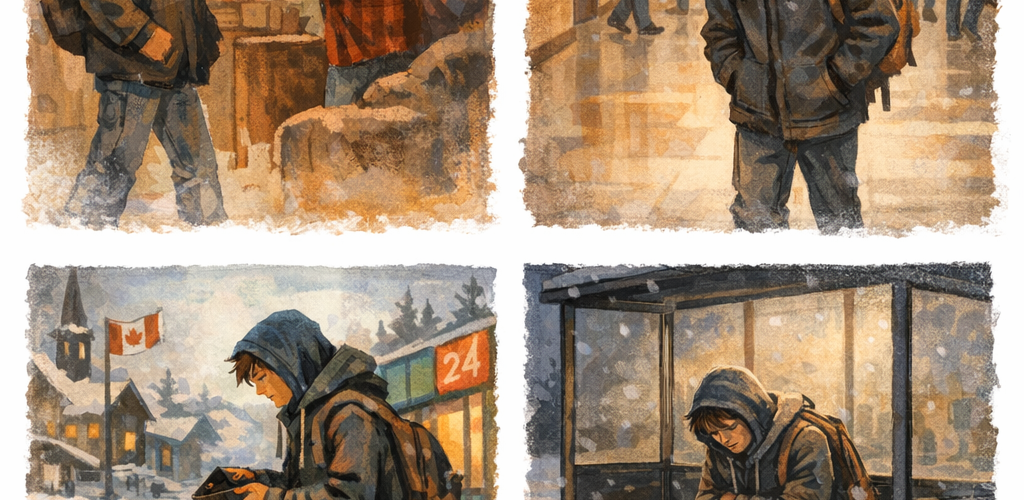
Youth homelessness is often hidden, but it can hurt for life
Credit: Microsoft Copilot/GPT-4o
This is the first of two posts addressing youth homelessness by SRPC member Cassandra Vink. Cassandra is a social policy consultant with particular expertise in housing and homelessness. She also serves on the Shelterlink Board of Directors.
The title of this post comes from the poem “We Are” by Phoebe Nana-Aubynn, a Virtual Volunteer with Youth Without Shelter.
Youth homelessness is a serious but often overlooked issue. Its impacts on young people, families, and communities can be long-lasting, even though it’s not as obvious as adult homelessness.
In this post, youth homelessness refers to young people aged 13 to 24 who don’t have a safe, stable place to live, whether they’re sleeping outside, staying in shelter, or cycling through temporary places to stay1.
This week, we’ll use national research to show the scale of youth homelessness in Canada. Next week, we’ll explore local provider data to see what it looks like here in Huron and Perth. By connecting national evidence with local data, we aim to support community awareness, planning, and action to prevent and end youth homelessness.
How big is the problem?
Youth homelessness affects tens of thousands of young people in Canada every year, and it’s rising at a pace that should worry all of us. Even before the pandemic, 35,000 – 40,000 Canadian youth experienced homelessness annually, with at least 6,000 youth homeless on any given night2. Since then, homelessness has increased, and newer data suggests that the nightly count now exceeds 10,0003.
In Ontario, known homelessness across all ages increased by 7.8% in 2025. Looking ahead, a recent HelpSeeker report commissioned by the Association of Municipalities of Ontario (AMO) projected that homelessness could double over the next 10 years under steady conditions, and could rise to 3.5 times today’s levels in an economic downturn4. If we want to change this trajectory, we need to invest now in the supports that help young people stay housed, connected, and stable.
And here’s the catch: even these big numbers mostly count the youth we can see — those staying in dedicated shelters, placed in motels, or sleeping outside. Many more youth experience “hidden homelessness,” cycling between the homes of friends, extended family, and acquaintances. These situations can look fine from the outside, but they’re still homelessness. The young person often can’t stay long-term, may not have their own key, and can be asked to leave at any time. They don’t have a safe, stable home they can count on. Hidden homelessness rarely shows up in formal counts. That’s why the true scale of youth housing instability is almost certainly higher than what shelter and street counts capture.
The numbers are striking: the 2018 Canadian Housing Survey found that 18% of youth aged 15 to 29 had experienced hidden homelessness, almost one in five5. It’s worth noting that this estimate is based on youth who were responsible for housing decisions in their household, which means it skews toward young people living more independently and doesn’t capture youth who were living with parents at the time of the survey.
This has major implications. If so many youth are navigating homelessness outside shelters and street counts, we can’t rely on the homelessness system to be the first place they seek help. Prevention and early intervention need to show up in the places where youth already are, like schools, community health settings, youth-serving agencies, and family support programs, so housing instability can be recognized early, and youth can be connected quickly to the right mix of supports.
This matters because youth homelessness is often the beginning of a longer story. National data shows that 44% of people who have ever experienced homelessness first became homeless before age 256, and early homelessness is linked to serious long-term impacts, from poorer health to greater risk of chronic homelessness later in life7. What’s especially concerning is that more young people are getting stuck for longer: in the 2018 national Point-in-Time (PiT) Count, 53% of youth counted were experiencing chronic homelessness, rising to 58% between 2020 and 20228. As rents rise, vacancies tighten, and affordable rooms and entry-level apartments disappear, fewer youth can “self-resolve” a housing crisis. That’s why communities need stronger pathways out of homelessness for youth and supports to help them stay housed.
Who is experiencing homelessness?
Youth experiencing homelessness come from many backgrounds, but national data shows clear patterns in who is most affected. Young men are counted more often than young women, although PiT Count data suggests youth homelessness is closer to gender balance (42% young women, 52% young men, 6% gender-diverse) than adult homelessness (32% women, 66% men, 2% gender-diverse)9. There are many possible explanations for this gender gap. Men may feel safer sleeping unsheltered or in co-ed shelters, while women of all ages may instead stay temporarily with friends/partners, exchange sex for a place to stay, or avoid shelters that feel unsafe, so they can be undercounted in street-based data. In any case, the gender gap appears to be less dramatic for youth.
By contrast, gender-diverse people are much more overrepresented in youth homelessness numbers. They make up 6% of youth experiencing homelessness, 2% of adults experiencing homelessness, and less than 1% of the general population10. Gender diversity may appear so much more among youth experiencing homelessness partly because younger people may be more comfortable identifying as gender-diverse and partly because gender-diverse youth face greater risks of rejection and discrimination. That can make homelessness more likely and harder to exit.
Many youth experiencing homelessness are also navigating health and developmental challenges that make it harder to find and keep stable housing. In the PiT Count, 67% reported a mental health issue and 56% reported a substance-use issue11. 47% reported learning or cognitive challenges, 21% an illness or medical condition, and 15% a physical limitation12. This is why housing needs to come with follow-along supports, especially mental health and addiction supports, practical help with daily living, and help keeping housing.
Experiences in government care are another major thread: 45% of youth experiencing homelessness reported past involvement in foster care, group homes, or other child-welfare programs, and youth with care experience were more likely to become homeless at a younger age13. Think about what that means: many youth enter these programs because home isn’t safe or stable. Yet after all that intervention, they still end up without a safe place to live. This highlights gaps in support during and after care, especially through the transition to adulthood. Stronger, longer transition planning and better coordination across child welfare, housing, income supports, and youth services can help prevent youth from falling through the cracks.
Finally, some groups are disproportionately affected, such as 2SLGBTQ+ and Indigenous youth. Without a Home: The National Youth Homelessness Survey (2015) found that, among surveyed youth, 29.5% identified as 2SLGBTQ+ and 30.6% as Indigenous. That compares to 10.5% of the total youth population identifying as 2SLGBTQ+14 and 6.7% as Indigenous15. Meanwhile, 28.2% of surveyed youth identified as racialized and 10.1% were born outside Canada, sizable groups with potentially distinct needs16. These identities can overlap, shaping both pathways into homelessness and the risks youth face while homeless, including discrimination, violence, barriers to services, and, for Indigenous youth, cultural disconnection when services don’t reflect their culture or community.
Why do youth become homeless?
Youth homelessness rarely has a single cause. More often, it reflects a mix of family conflict, system involvement, trauma, and structural inequities. Unlike adults, youth are most likely to become homeless because of interpersonal conflict: 51% said interpersonal issues contributed to their most recent housing loss, and 30% specifically reported conflict with a parent or guardian17. “Conflict” often means much more than typical parent–teen tension. It can include being forced to leave, living with violence or coercive control, facing rejection (including related to 2SLGBTQ+ identity), or trying to cope in a home made unstable by addiction, mental health crises, or poverty. In other words, youth often become homeless because home stops being safe or workable. For many youth, leaving home is a response to unsafe, unstable, or rejecting conditions, not simply a matter of choice.
This is especially true for 2SLGBTQ+ youth, who are more likely to experience family rejection and abuse, increasing both their risk of homelessness and the likelihood of longer periods without stable housing. Many youth experiencing homelessness have also faced trauma or violence, time in foster care or other government care, mental health or substance use concerns, developmental or cognitive disabilities, and school barriers linked to learning needs, stigma, or instability. Layered on top of these individual and family circumstances are structural inequities: poverty, discrimination (including racism, homophobia, transphobia, or ableism), limited access to services, and a shortage of affordable, youth-appropriate housing. With all these pressures compounding, all it can take is a small crisis or conflict to tip a young person into homelessness.
These posts coincide with Coldest Night of the Year, “a winterrific family-friendly fundraising walk in support of local charities serving people experiencing hurt, hunger, and homelessness.” Coldest Night of the Year will be held on February 28, 2026, in six locations across Huron-Perth, raising funds for various local charities including Shelterlink, regional Connection Centres, and other homelessness programs.
United Insights: A Research Blog by SRPC
Subscribe to get United Insights in your inbox.
Got research-loving friends? Send them this post!
Did your research-loving friend send you this? Subscribe
Love this post? Strongly dislike it? Got suggestions? Let Us Know
Citations:
- Gaetz, S., O’Grady, B., Kidd, S., Schwan, K., & Canadian Observatory on Homelessness. (2016). Without A Home: The National Youth Homelessness Survey. In COH RESEARCH REPORT. Canadian Observatory on Homelessness Press. https://homelesshub.ca/sites/default/files/WithoutAHome-final.pdf
- Gaetz, S., Dej, E., Richter, T., Redman, M., Canadian Observatory on Homelessness, Canadian Alliance to end Homelessness, Marsolais, A., Donaldson, J., Thistle, J., & Schwan, K. (2016). The State of Homelessness in Canada 2016. In The State of Homelessness in Canada 2016 [Report]. Canadian Observatory on Homelessness Press. https://www.homelesshub.ca/sites/default/files/SOHC16_final_20Oct2016.pdf
- The 2020-2022 Nationally Coordinated Point-in-Time (PiT) Counts found that youth represented 12% of survey respondents experiencing homelessness. Age breakdowns for the 2024 Nationally Coordinated PiT Count are not yet available, but data that has been released shows a rate of homelessness of 26 people per 10,000. Assuming youth represented a consistent portion in 2024, this would mean that more than 10,000 youth experience homelessness on any given night.
- Donaldson, J., Kandyba, L., Wang, D. (2026). Municipalities Under Pressure One Year Later: An Update on the Human and Financial Cost of Ontario’s Homelessness Crisis. HelpSeeker
- Government of Canada, Statistics Canada. (2022, March 14). “A portrait of Canadians who have been homeless.” https://www150.statcan.gc.ca/n1/pub/75-006-x/2022001/article/00002-eng.htm
- Infrastructure Canada. (2022). “Homelessness data snapshot: Youth homelessness in Canada.” In Everyone Counts 2020-2022 – Results From the Third Nationally Coordinated Point-in-Time Counts of Homelessness in Canada. https://housing-infrastructure.canada.ca/alt-format/pdf/homelessness-sans-abri/reports-rapports/youth-homelessness-2024-itinerance-jeunes-en.pdf
- Infrastructure Canada. (2022). Homelessness data snapshot: Youth homelessness in Canada. In Everyone Counts 2020-2022 – Results From the Third Nationally Coordinated Point-in-Time Counts of Homelessness in Canada. https://housing-infrastructure.canada.ca/alt-format/pdf/homelessness-sans-abri/reports-rapports/youth-homelessness-2024-itinerance-jeunes-en.pdf
- Infrastructure Canada. (2022). “Homelessness data snapshot: Youth homelessness in Canada.” In Everyone Counts 2020-2022 – Results From the Third Nationally Coordinated Point-in-Time Counts of Homelessness in Canada. https://housing-infrastructure.canada.ca/alt-format/pdf/homelessness-sans-abri/reports-rapports/youth-homelessness-2024-itinerance-jeunes-en.pdf
- Infrastructure Canada. (2022). “Homelessness data snapshot: Youth homelessness in Canada.” In Everyone Counts 2020-2022 – Results From the Third Nationally Coordinated Point-in-Time Counts of Homelessness in Canada. https://housing-infrastructure.canada.ca/alt-format/pdf/homelessness-sans-abri/reports-rapports/youth-homelessness-2024-itinerance-jeunes-en.pdf
- Statistics Canada. (2022, April 27). “Canada is the first country to provide census data on transgender and non-binary people.” The Daily. https://www150.statcan.gc.ca/n1/daily-quotidien/220427/dq220427b-eng.htm
- In the PiT Count survey, “substance use issue” was prompted with examples that included tobacco, which may influence how respondents interpret and report substance use issues.
- Infrastructure Canada. (2022). “Homelessness data snapshot: Youth homelessness in Canada.” In Everyone Counts 2020-2022 – Results From the Third Nationally Coordinated Point-in-Time Counts of Homelessness in Canada. https://housing-infrastructure.canada.ca/alt-format/pdf/homelessness-sans-abri/reports-rapports/youth-homelessness-2024-itinerance-jeunes-en.pdf
- Infrastructure Canada. (2022). “Homelessness data snapshot: Youth homelessness in Canada.” In Everyone Counts 2020-2022 – Results From the Third Nationally Coordinated Point-in-Time Counts of Homelessness in Canada. https://housing-infrastructure.canada.ca/alt-format/pdf/homelessness-sans-abri/reports-rapports/youth-homelessness-2024-itinerance-jeunes-en.pdf
- Statistics Canada. (2024). “Canada at a glance, 2023: 2SLGBTQ+ population.” Government of Canada. https://www150.statcan.gc.ca/n1/pub/12-581-x/2023001/sec6-eng.htm [www150.statcan.gc.ca]
- Statistics Canada. (2021). “Portrait of youth in Canada: Data report—Chapter 4: Indigenous youth in Canada.” Government of Canada. https://www150.statcan.gc.ca/n1/pub/42-28-0001/2021001/article/00004-eng.htm
- Gaetz, S., O’Grady, B., Kidd, S., Schwan, K., & Canadian Observatory on Homelessness. (2016c). Without A Home: The National Youth Homelessness Survey. In COH RESEARCH REPORT. Canadian Observatory on Homelessness Press. https://homelesshub.ca/sites/default/files/WithoutAHome-final.pdf
- Infrastructure Canada. (2022). “Homelessness data snapshot: Youth homelessness in Canada.” In Everyone Counts 2020-2022 – Results From the Third Nationally Coordinated Point-in-Time Counts of Homelessness in Canada. https://housing-infrastructure.canada.ca/alt-format/pdf/homelessness-sans-abri/reports-rapports/youth-homelessness-2024-itinerance-jeunes-en.pdf