





Seeing the world through two lenses and creating better pathways for Indigenous children, youth, and families.
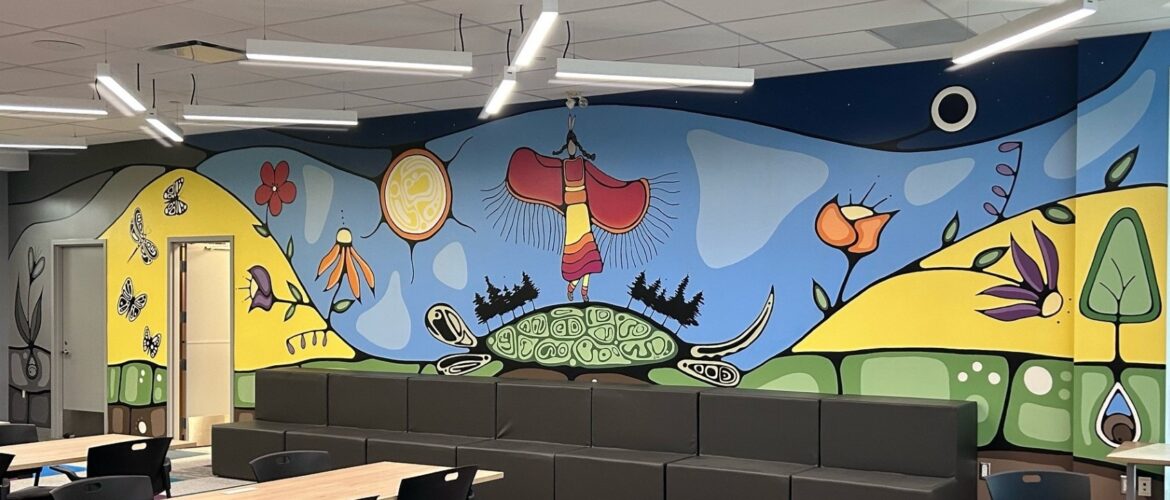
The Commons, a room at Huron-Perth Children’s Aid Society, features a mural by Jeannette Ladd, an Anishinaabe-kwe artist from Saugeen First Nation. Courtesy of Huron-Perth Children’s Aid Society.
This is a post by Saranne Whetung, the Mino-Bimaadiziwin Circle and Volunteer Services Program Manager at Huron-Perth Children’s Aid Society.
At Huron-Perth Children’s Aid Society, we are continuing to learn what it means to walk alongside Indigenous children, youth, families, and communities in a way that honours culture, community, relationships, and the inherent strengths of Indigenous peoples.
One concept that has helped shape this journey is Two-Eyed Seeing.
Two-Eyed Seeing invites us to recognize the strengths of Indigenous ways of knowing alongside the strengths of Western ways of knowing. Rather than choosing one perspective over the other, it encourages us to learn from both and to understand that each can offer something valuable.
Two-Eyed Seeing
The concept of Two-Eyed Seeing was introduced by Mi’kmaw Elder Albert Marshall, who described it as learning to see the world through one eye with the strengths of Indigenous knowledges and ways of knowing, and through the other eye with the strengths of Western knowledges and ways of knowing.
This concept asks us to pause and consider: What might we see if we looked through more than one lens?
For Indigenous families navigating systems that have historically caused harm, this way of thinking can be particularly meaningful.
I grew up as an Anishinaabe kwe (First Nations woman) in a colonial society which meant navigating systems and mainstream institutions that were not designed with consideration for my family, culture, or community. Throughout the entirety of my life, this has meant that every day I am shifting between Indigenous ways of knowing and Western ways of knowing, and often receiving little to no support to bridge the two.
“We Can’t Just Live in the Bush Every Day”
There is a practical reality to the concept of Two-Eyed Seeing.
We, as Indigenous people, continue to live in the advancing modern world. Our families interact with Western schools, health care, justice systems, child welfare, workplaces, and many other institutions. At the same time, our Indigenous culture, language, ceremony, land, family, community, and traditional knowledge remain deeply important to us.
For myself, while I’m navigating difficult experiences in the Western world, I need the self-discipline to revisit my upbringing, my teachings, and my values, to remind myself of who I am as a person. In every situation, I have to give myself those reminders, and be kind with myself as I navigate those two worlds. When I face rigid norms and societal expectations that come from a colonial culture, I remind myself that not everyone sees through the lens I do. It’s not about having one right way or one wrong way. This awareness of different ways of seeing lets me ground myself and hold respect for other people and their ways of knowing, even if I don’t agree.
The answer isn’t to choose one world over another. It is to find ways for both to exist together. For many Indigenous families, that has not always been available.
One-Eyed Seeing and the History of Child Welfare
To understand why this work matters for children’s aid societies, we also need to acknowledge the history of child welfare and its relationship with First Nations, Inuit, and Métis (FNIM) peoples.
For generations, colonial systems — especially residential schools and child welfare — were used to separate Indigenous children from their families, communities, cultures, and identities. The devastating legacy of these policies continues to affect Indigenous families today — this is what we call intergenerational trauma.
The child welfare system has therefore not always been experienced as a source of support or safety by Indigenous communities. In many cases, it has been a major cause of harm.
It is important to note that recognizing this history is not about assigning blame to individuals working in child welfare today. It is about understanding why trust can be difficult to build, why relationships matter, and why meaningful change requires more than simply changing policies.
It requires changing not only how we see, but also how we act.
Bringing Two-Eyed Seeing to Child Welfare
Within Ontario’s child welfare system, reforms have increasingly emphasized the importance of working alongside First Nations, Inuit, and Métis communities. This includes ensuring that Indigenous voices are part of decisions affecting Indigenous children, youth, and families.
At Huron-Perth Children’s Aid Society, this has included strengthening the relationship between protection services, who respond to reported concerns with particular children and families, and community engagement, who provide proactive, preventative support for those families. It has included working more intentionally with FNIM communities. Important changes have been made — including upholding the Indigenous concept of Two-Eyed Seeing — to strengthen Indigenous participation and community involvement in child welfare.
Historically, First Nations, Inuit, and Métis people were often involved in child welfare only when their families were deemed problematic. These new changes hope to involve Indigenous community members in positive, collaborative relationships to build community and support Indigenous children and families in Huron-Perth.
There are also legislative requirements around connecting with FNIM representatives when Indigenous children, youth, and families become involved with child welfare. If we receive reports about a child with a connection to a particular Indigenous Nation, we contact that Nation so they can support that child and/or their family. While these requirements are important, we as an organization must also recognize that what is required by legislation is only a starting point for meaningful relationship-building with Indigenous communities in and beyond Huron and Perth.
Bridging the Rural Gap
In a rural and geographically dispersed region like Huron-Perth, there are practical challenges in accessing the right supports and connections.
Band and Nation representatives, as well as First Nations, Inuit, and Métis community partners bring invaluable knowledge, relationships, and cultural perspectives. At the same time, there may be circumstances where community representatives cannot immediately be available to support a family or participate in a particular conversation.
This is part of what led to the development of the Huron-Perth Children’s Aid Society Mino-Bimaadiziwin Circle.
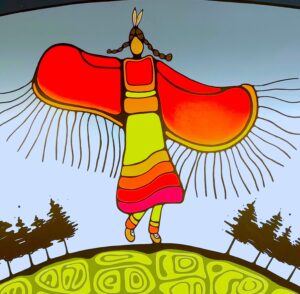
A dancer on the back of the turtle in a mural by Jeanette Ladd at Huron-Perth Children’s Aid Society. Courtesy of Huron-Perth Children’s Aid Society.
The Mino-Bimaadiziwin Circle
Mino-Bimaadiziwin in the Ojibwe language translates to “the good life.” This concept speaks to living in a good way in all senses, and being connected or reconnected to family, community, culture, land, and relationships — following the red road we were placed on as Indigenous people.
The Mino-Bimaadiziwin Circle is one way Huron-Perth Children’s Aid Society is working to bring Two-Eyed Seeing into practice.
The Circle was created to support First Nations, Inuit, and Métis children, youth, and families as an additional resource within the agency. The Circle is a group of FNIM staff, community Knowledge Keepers, and a community grandmother working in collaboration. The group is constantly communicating, meeting as needed, to meet the evolving cultural needs of the Indigenous children and families associated with Huron-Perth Children’s Aid Society, and the broader community. The dedicated staff offer FNIM-specific programming and one-to-one support for children, youth, and families with a cultural lens. The Circle also provides education to the community as a whole.
The Circle creates opportunities for cultural understanding, relationship-building, and meaningful support by honouring the diverse cultures, traditions, teachings, and perspectives of FNIM peoples. Honouring this diversity is essential to building trust, strengthening relationships, and ensuring that the work of the Circle is culturally responsive and grounded in respect. It also recognizes and values the unique cultural identities and lived experiences of the staff and knowledge keepers who make up the Circle, creating a space where their knowledge, voices, and connections to community are respected and celebrated.
By bringing together staff and community-connected voices with different cultural backgrounds and experiences, the Circle creates an opportunity for them to learn from one another, challenge assumptions, and better understand the unique needs of the communities we serve. This collective knowledge helps ensure that FNIM perspectives are meaningfully represented and that cultural understanding is woven into the work of Huron-Perth Children’s Aid Society.
We have had only one eye open for many years — this Circle is helping us to open the other one.
Relationships Before Solutions
One of the most important lessons in the work that I do is that relationships cannot be treated as an afterthought.
Building stronger relationships with First Nations, Inuit, and Métis organizations, Elders, Knowledge Keepers, community members, and families takes time. It requires consistency, humility, and a willingness to listen.
The Mino-Bimaadiziwin Circle is helping create those connections while also strengthening the Society’s relationships with FNIM communities.
While there is still so much work to do, we are seeing encouraging results in the steps we are taking as an organization.
Staff are developing greater confidence in engaging with Indigenous families and communities. Conversations about culture and identity are happening immediately, through the intake process. Connections are being strengthened.
Looking Forward, Two Eyes Open
This work is not finished, and it isn’t something that can be finished by creating a single program, policy, or committee.
Two-Eyed Seeing is a way of continuing to learn.
It challenges us to ask better questions:
What are we missing? Whose voice needs to be at the table?
What does this child and family need to feel connected, supported, and understood?
How can we work alongside community rather than simply working on behalf of community?
The Mino-Bimaadiziwin Circle represents an exciting step forward for Huron-Perth Children’s Aid Society. As we continue to build relationships, expand community connections, and strengthen culturally responsive practice, we are creating more opportunities for First Nations, Inuit, and Métis children, youth, and families to experience child welfare differently — as the source of support and safety it is meant to be.
There is also something powerful about recognizing that this work builds on the efforts of those who came before us.
Many First Nations, Inuit, and Métis parents, grandparents, community members, and advocates have spent years navigating systems that did not always see, understand, or value them. They persisted, and found ways to bring Indigenous ways of knowing into spaces where they were not always welcomed or supported.
Today, we have an opportunity to carry that work forward: with stronger relationships, more community support, and a greater willingness to listen.
That is what Two-Eyed Seeing can mean in child welfare.
Not choosing one way of seeing over another.
But opening both eyes, seeing more clearly, and using what we see to create better outcomes for children, youth, families, and communities.
Huron-Perth Children’s Aid Society’s Commitment to Reconciliation
At Huron-Perth Children’s Aid Society, we recognize that reconciliation is an ongoing journey. We remain committed to listening, learning, building relationships, and strengthening the ways we support First Nations, Inuit and Métis children, youth, families, and communities across Huron and Perth.
The work continues; and we are grateful to everyone who is walking alongside us.
About the Author
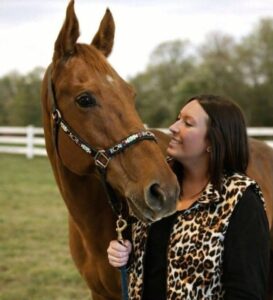
Saranne Whetung
Saranne (Sara) Whetung is Ojibwe-Anishinaabe of Curve Lake First Nation and grew up immersed in her Anishinaabe culture from birth. She is the Mino-Bimaadiziwin Circle and Volunteer Services Program Manager at Huron-Perth Children’s Aid. Sara grew up north of Peterborough, Ontario, on beautiful Stoney Lake. Her family moved off reserve to the lake, where they built a successful business, instilling in Sara a strong appreciation for hard work, entrepreneurship, community, and the importance of staying connected to her roots and culture.
Sara has pursued a variety of university degrees, including studies at Trent University and the University of Guelph. Her educational and professional journey reflects her lifelong commitment to learning, growth, and supporting children, families, volunteers, and communities.
Outside of her professional life, Sara has a lifelong passion for horses and the equestrian world. She has spent many years showing and competing in the hunter/jumper discipline, developing a deep appreciation for the partnership, discipline, and dedication that come with riding and competing. She has also had the privilege of coaching many young riders, helping them develop their skills and confidence and supporting them as they progressed to advanced levels of competition.
When she’s not working or at the barn, Sara can be found travelling, spending time outdoors, and living life to the fullest. She loves embracing new adventures and making the most of every opportunity, especially alongside her six-pound Chihuahua named Bird.
National Day for Truth and Reconciliation Community Gathering
National Day for Truth and Reconciliation is September 30.
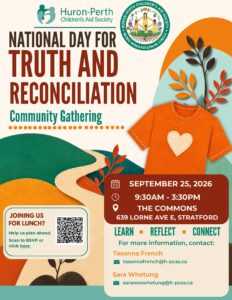
Huron-Perth Children’s Aid Society warmly invites community members to join their National Day for Truth and Reconciliation Community Gathering.
This gathering is an opportunity to come together in reflection, learning, and community as we honor, remember and recognize the ongoing journey toward truth and reconciliation.
Everyone is welcome to attend. There is no cost to attend.
📅 September 25, 9:30 a.m. – 3:30 p.m.
📍 Location: The Commons, HPCAS Stratford Office
🍽️ Lunch: Please register in advance.
As part of the day, we will also come together for a community walk from 2:15–3:30 p.m. This walk will provide an opportunity to gather as a community, reflect on the meaning of Truth and Reconciliation, honor Survivors and those who were lost, and carry our learning and commitment forward together.
📋 Find more information on Destination Stratford. Register in advance if you are joining for lunch.
For other programming in Perth and Huron, see event listings from Huron County Library, event listings from Destination Stratford (click load more at bottom of page), and event listings from Town of St. Marys.
United Insights: A Research Blog by SRPC
Subscribe to get United Insights in your inbox.
Got research-loving friends? Send them this post! (Did your research-loving friend send you this? Subscribe!)
Love this post? Strongly dislike it? Got suggestions? Let Us Know
Got an idea for a post? Pitch It