





The Realities Facing 2SLGBTQ+ People in Perth and Huron
Circles Not Squares by Baz Kanold. Kanold is a Waterloo-region artist whose work was recently exhibited at the Exeter library.
This United Insights post presents highlights from the Social Research and Planning Council’s new report, Discrimination and Community Integration Experienced by 2SLGBTQ+ in Perth-Huron.
2SLGBTQ+ people in the mostly rural region of Perth-Huron experience unique barriers that often go understudied. The Social Research and Planning Council (SRPC) partnered with the University of Guelph’s School of Environmental Design and Rural Development (SEDRD) and the Community Engaged Scholarship Institute (CESI) to fill a gap in information available on the experiences of the 2SLGBTQ+ community within the region. In particular, the study sought to understand the lived experience, barriers to inclusion, and support needs of 2SLGBTQ+ people.
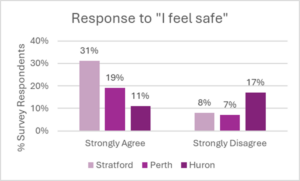
Figure 1. 2SLGBTQ+ feelings of safety across Perth-Huron. Credit: Community Engaged Scholarship Institute (CESI)
“A lot of [2SLGBTQ+ people] aren’t loud, and a lot of them are concerned about being seen […] because they don’t feel safe.” – Survey Respondent
When survey respondents were asked if they agreed with the statement “I feel safe”, 17% in Huron County strongly disagreed with the statement, compared to 7% in Perth County and 8% in Stratford. These numbers only tell part of the story. Across all three research methods in the study (survey, interviews, and a participatory workshop), people shared that feeling unsafe wasn’t just limited to their physical communities. These feelings also extended to virtual spaces such as community Facebook groups. During the participatory workshop, participants linked this feeling in part to the rise of hate groups and hate speech within the region.
“I find much of the local social media quite challenging especially around Pride month. There was significant open hostility when Stratford announced on Facebook that they were closing the street to repaint the rainbow crosswalk, with over 150 hateful comments within an hour of the post” – Interview Participant
The experiences of discrimination were even more striking. Three‑quarters of survey participants said they had witnessed discrimination targeting 2SLGBTQ+ people within the past five years. More than half of 2SLGBTQ+ respondents had faced direct discrimination themselves. Breaking it down further, 62% of respondents from Huron County reported personal experiences of discrimination, compared to 53% in Perth County and 40% in Stratford.
Who was responsible? For many, it was strangers. 73.3% of those who experienced discrimination said it came from people they didn’t know. 54.7% reported discrimination from peers, 30.7% from people in positions of power, and 25.3% from family members. The forms of discrimination ranged from overt verbal harassment to quieter, but still harmful, side comments.
It comes as little surprise that 68 of 147 2SLGBTQ+ survey participants indicated that they were considering leaving the region or had already left. Five commonly cited reasons for wanting to leave were:
- No sense of belonging
- Inability to express their 2SLGBTQ+ identities
- Not enough 2SLGBTQ+ people
- Not enough services for 2SLGBTQ+ people
- Did not feel safe
As one workshop participant put it:
“Isolation and the queer community is a real thing and making sure service providers really understand and internalize it. That it’s not enough for the police just to go, ‘Oh we’re sorry that your business [was] vandalized or that there’s protesters showing up to your march.’”
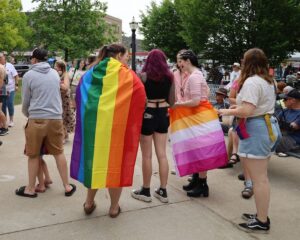
Attendees at the first annual Huron County Pride Festival in June 2023. Credit: Nick McGregor, on behalf of Huron County Pride.
Belonging is not something that can always be easily measured. However, when it’s missing, people feel it deeply:
“I definitely didn’t feel like I had a lot of people around me, that I could connect with in that sort of way.” – Interview Participant
When asked if they agree with the statement “I feel I belong”, 25% of respondents from Huron strongly disagreed, while 14% from Perth and 6% from Stratford strongly disagreed. These numbers echo what many participants shared throughout the study: that their identities often don’t feel accepted in their communities. Without visible signs of inclusion, whether that’s representation, supportive messaging, or simply knowing there are others like them, many 2SLGBTQ+ people described feeling unable to express themselves openly. Discriminatory attitudes and cultural norms in the region only deepen that sense of constraint.
Participants emphasized the need for more visible signals of support—flags, signs, inclusive messaging, and designated safe spaces. They also highlighted gaps in essential services. Survey respondents said they wanted access to healthcare providers who are knowledgeable about 2SLGBTQ+ care, one‑on‑one counselling, and peer or support groups.
Service providers who participated in the study echoed some of these concerns. They identified several barriers that make it difficult to offer affirming, accessible support:
- Not enough information about needs of 2SLGBTQ+ individuals
- Insufficient training or expertise in identity affirming care
- Resistance from colleagues or peers
- Financial constraints
- Transportation barriers
- Lack of support from organizational leadership
Taken together, these insights paint a picture of a region where many 2SLGBTQ+ residents feel unseen, unsupported, and disconnected. Many 2SLGBTQ+ community members in Huron-Perth region face isolation and discrimination. There is a need for more inclusive service provision and more inclusive spaces within Perth and Huron. There are also clear opportunities for more visibility, more education, more leadership, and more intentional efforts to build communities where everyone can feel they belong.
For more information on this research and our community recommendations, read the full report: Discrimination and Community Integration Experienced by 2SLGBTQ+ in Perth-Huron.
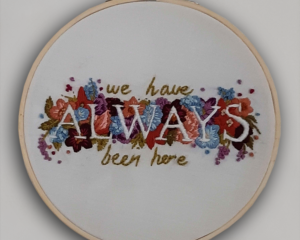
We Have Always Been Here by Baz Kanold.
February is Black History Month! Black History Month is an important time to reflect on progress made on Canada’s commitments towards addressing anti-Black racism and learning about the diversity of the Black Community in Canada and the legacy of Black leadership and contributions. Local events announced so far include a new exhibit at Stratford Perth Museum. You can find more information about Black History Month in Canada here.
United Insights: A Research Blog by SRPC
Subscribe to get United Insights in your inbox.
Got research-loving friends? Send them this post!
Did your research-loving friend send you this? Subscribe
Love this post? Strongly dislike it? Got suggestions? Let Us Know